Gene Siskel Film Center Chicago, IL
Dr. Yuan Chang (YC) Leong
Assistant Professor of Psychology, University of Chicago
Experimenter— On Hurting Others
Program Description
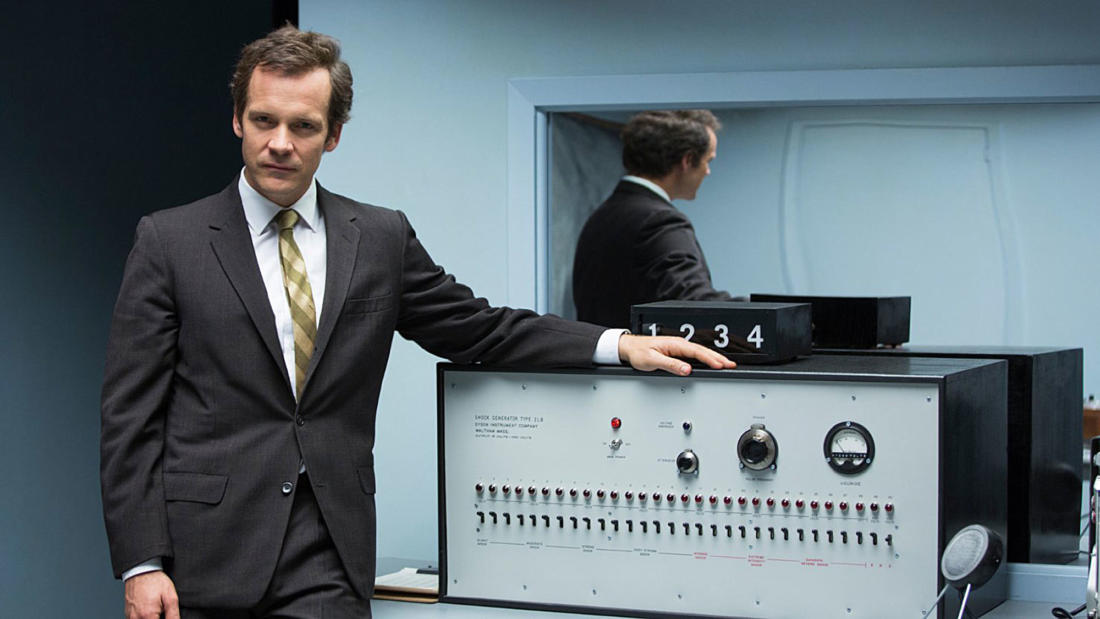
Based on a true story, EXPERIMENTER follows famed social psychologist Stanley Milgram, who conducted a series of radical behavior experiments in the early sixties testing ordinary humans' willingness to obey authority by using electric shock. Why is it so easy to go along with the will of others? After the screening, Yuan Chang (YC) Leong, Assistant Professor of Psychology at the University of Chicago, will join us for a conversation about why social context is so powerful, what modern psychology and neuroscience have learned since Milgram, and what his experiments still get us thinking about today.
This event is part of the National Evening of Science on Screen. Learn more.
Presented At
Gene Siskel Film Center Chicago, IL
Film Synopsis
In 1961, famed social psychologist Stanley Milgram conducted a series of radical behavior experiments that tested ordinary humans willingness to obey authority.
Based on a true story, the film follows famed social psychologist Stanley Milgram (Peter Sarsgaard), who in 1961 conducted a series of radical behavior experiments that tested ordinary humans' willingness to obey by using electric shock. The story traces Milgram's life, from meeting his wife Sasha (Winona Ryder) through his controversial experiments that sparked public outcry.
About the Speaker
Yuan Chang (YC) Leongis an Assistant Professor of Psychology at the University of Chicago. He received his A.B. in Psychology from Princeton University and his Ph.D. in Psychology from Stanford University. He then completed his postdoctoral training at the Helen Wills Neuroscience Institute at the University of California, Berkeley before moving to the University of Chicago. Research in his lab investigates the neural and computational mechanisms underlying how goals, beliefs, and emotions influence human cognition. He probes this question across multiple levels of cognitive processing, from perception and attention, to memory and decision-making, to affective and social reasoning. His work uses a combination of convergent tools, including functional brain imaging (e.g., fMRI, fNIRS), naturalistic task paradigms, computational cognitive models, natural language processing tools, and machine learning methods.