The Grand Cinema Tacoma, WA
Erik Tou, Ph.D.
Associate Professor of Sciences and Mathematics, Department of School of Interdisciplinary Arts and Sciences, University of Washington Tacoma
The Imitation Game— Of Mind and Machine: The Life and Legacy of Alan Turing
Program Description
One of the first computer scientists, Alan Turing developed a theory of artificial intelligence, described programming for a "universal machine" (today called a "computer"), and was instrumental in breaking the Nazi Enigma cipher during World War II. We'll explore some of the mathematical ideas behind the Enigma cipher and Turing's attack on it, and reflect on his experience as a gay man living a time when homosexuality was criminalized in the United Kingdom.
This event is part of the National Evening of Science on Screen. Learn more.
Presented At
The Grand Cinema Tacoma, WA
Film Synopsis
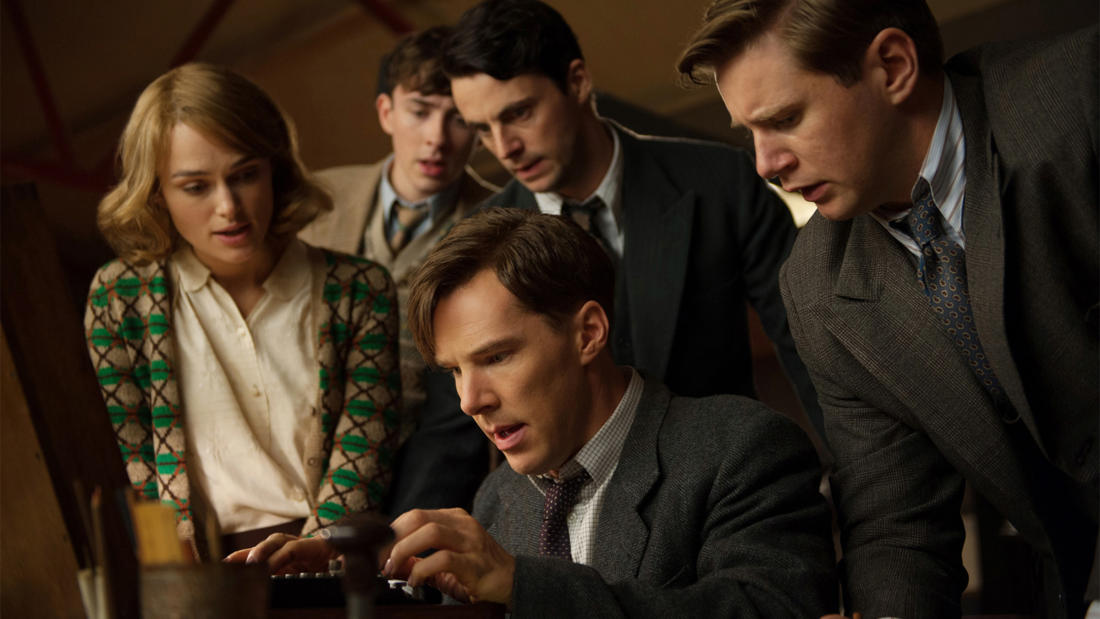
During World War II, mathematician Alan Turing tries to crack the enigma code with help from fellow mathematicians.
Told via flashback, The Imitation Game tracks the young, brilliant, and socially awkward mathematician Alan Turing (Benedict Cumberbatch) in the early days of World War II as he applies for a top-secret position tasked with decoding the “unbreakable” Nazi cipher machine called Enigma, used to encrypt all military radio transmissions. Turing's team, including Joan Clarke (Keira Knightley), analyzes Enigma messages while he builds a machine to decipher them. His work was famously labeled by Winston Churchill as “the greatest single contribution to victory.” But after the war he suffered great personal and professional turmoil, as he dealt with his homosexuality in a time when it was illegal. The film was nominated in eight Academy Awards, including Best Picture, Best Director, Best Actor, and Best Supporting Actress. It won for Best Adapted Screenplay.
About the Speaker
Erik Tou, Ph.D., is an associate professor of Sciences and Mathematics in the Department of School of Interdisciplinary Arts and Sciences at University of Washington Tacoma. Erik currently serves as Chief Historian of the Euler Archive, a scholarly organization devoted to the collection, digitization, and translation of the works of 18th century Swiss mathematician Leonhard Euler. His research covers a wide range of topics, including the mathematics of juggling, zeta functions, and the Gaussian integers.