The Nickelodeon Columbia, SC
Lauren Steimer
USC Professor of Film and Media Studies
andDaniel Frost
USC Professor of Geophysics;
andEnrique Lopez Rodriguez
USC Professor of Astrophysics
The Martian— Survival by Science: Mars, Minds, and The Martian
Program Description
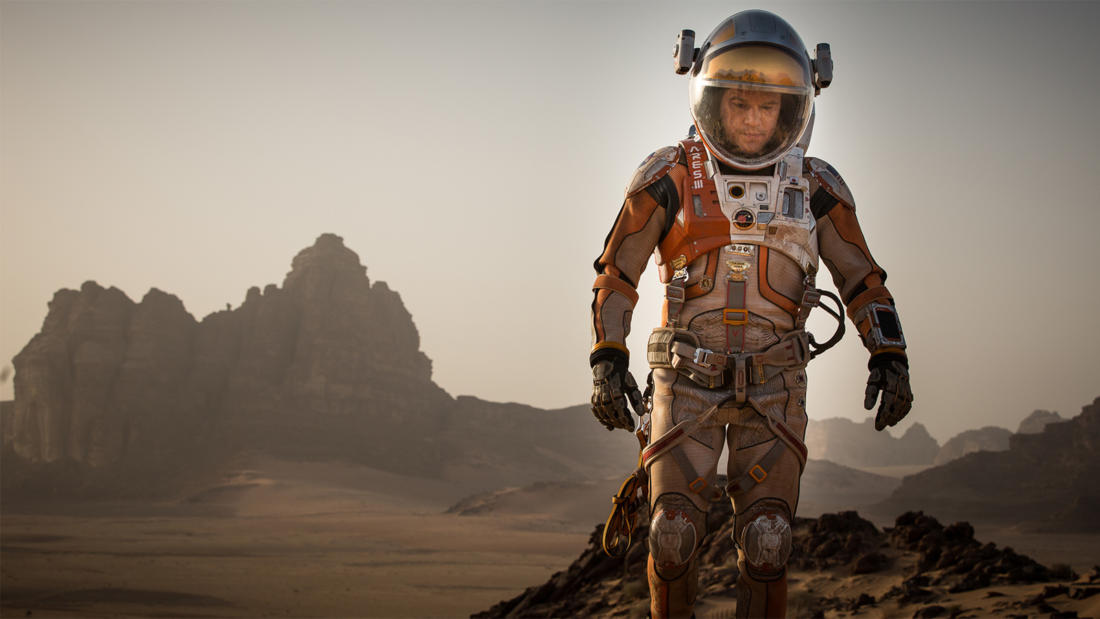
The Nick welcomes audiences for a special Science on Screen® presentation of Ridley Scott's The Martian, followed by a panel discussion that brings Mark Watney's fictional survival story down to Earth (and back out to Mars again).
After the credits roll on Matt Damon's ingenuity-driven fight for survival, three USC professors take the stage to unpack the real science behind the story. Dr. Enrique Lopez Rodriguez, an astrophysicist who studies galaxies and black holes using some of the world's most powerful telescopes, speaks to just how far modern astronomy has pushed our understanding of what lies beyond our own planet. Dr. Daniel Frost, a geophysicist who listens to earthquakes to map what's happening deep inside planets, shares insights on Martian geology and what seismic data from Mars and the Moon is teaching scientists about how planets form and evolve. And Dr. Lauren Steimer, an expert in stunt work and action performance, offers a different lens entirely: how the film's death-defying survival sequences are crafted, choreographed, and made to feel real.
Together, the panelists explore the true obstacles of space travel: the punishing limits of the human body, the unforgiving terrain of the Martian surface, and the split-second decisions (onscreen and off) that make survival stories so gripping. It's a night where rocket science, geology, and movie magic collide, proving once again that the best science fiction is often closer to science fact than we think.
Presented At
The Nickelodeon Columbia, SC
Film Synopsis
When astronauts mistakenly leave Mark Watney behind on Mars, the stranded visitor must use his wits, spirit, and scientific know-how to find a way to survive on the hostile planet.
During a manned mission to Mars, Astronaut Mark Watney (Matt Damon) is presumed dead after a fierce storm and left behind by his crew. But Watney has survived and finds himself stranded and alone on the hostile planet. With only meager supplies, he must draw upon his ingenuity, wit, and spirit to subsist and find a way to signal to Earth that he is alive. Millions of miles away, NASA and a team of international scientists work tirelessly to bring "the Martian" home, while his crewmates concurrently plot a daring, if not impossible, rescue mission. As these stories of incredible bravery unfold, the world comes together to root for Watney's safe return. Based on the best-selling novel by Andy Weir, and helmed by master director Ridley Scott, The Martian was nominated for three Golden Globes.
About the Speaker
Prof. Lauren Steimer is Associate Professor of Film and Media in the School of Visual Art and Design at the University of South Carolina. She is the foremost expert on global stunt work, design, regulation, history, and labor. Her book, Experts in Action: Transnational Hong Kong-style Stunt Work and Performance (Duke University Press, 2021), traces a distinct, embodied history of transnational exchange by identifying and defining unique forms of expert performance common to contemporary globalized action film and television genres.
Prof. Dan Frost explores what is inside the Earth by listening to reflections and refractions of the seismic waves from earthquakes as they travel through our planet. His interests stretch from what causes the earthquakes under Elgin, South Carolina to how the Earth’s solid iron inner core grows from the turbulent liquid iron outer core. He is fascinated by how planets grow and evolve, and is excited to learn more about other planets using seismometers that have been landed on Mars and the Moon.
Dr. Enrique Lopez Rodriguez is an Associate Professor at the Department of Physics and Astronomy at the University of South Carolina. His research focused on the study of the effect of magnetic fields on the evolution of galaxies across cosmic time and how these magnetic fields affect the accretion processes onto supermassive black holes at the center of galaxies. He is an observational astronomer making use of the largest international telescopes around the world to obtain the sharpest images of galaxies.